

 English
 русский
 Español
Content
Most sheet metal fabrication shops bend material from roughly 0.5 mm up to 6 mm as everyday production work. Add press brake tonnage, widen the V-die opening and shorten the bend line, and that ceiling climbs to about 10 to 12 mm. Beyond that, the job usually stops being sheet metal bending and becomes plate forming or rolling instead. Your real limit is decided by four variables: available tonnage, V-die opening, the length of the bend, and the tensile strength of the material.
Everything below explains where those numbers come from, how far they shift between mild steel, stainless steel and aluminum, and how to sanity-check a drawing before it ever reaches the brake.
Why a Thickness Limit Exists in the First Place
Air bending is the default method in most shops. The workpiece rests on the two shoulders of a V-die while the punch pushes material into the opening. The machine must supply enough force to take the material past its yield point along the entire bend line, and that force rises quickly as the sheet gets thicker.
Two relationships control everything. With a fixed V-die, required tonnage rises with the square of thickness, so doubling from 2 mm to 4 mm needs roughly four times the force. At the same time, the recommended V-die opening grows with the material, commonly eight times the sheet thickness for mild steel air bending. Because the die scales alongside the sheet, tonnage per meter becomes close to linear in thickness once the tooling is properly matched. Coining instead of air bending pushes force requirements up several times over, which is why it is reserved for tight, highly repeatable angles on thinner stock.
| Material thickness | Typical V-die opening | Approximate tonnage per meter | What it takes on the shop floor |
|---|---|---|---|
| 0.8 mm | 6 mm | 6 to 7 t/m | Any small press brake, high-speed machines included |
| 1.5 mm | 12 mm | 12 t/m | A 60 t class brake bends full length comfortably |
| 3 mm | 24 mm | 24 t/m | A 100 t brake over a 4 m bed is near its rated limit |
| 6 mm | 48 mm | 48 t/m | Needs a heavy brake or a shorter bend line |
| 10 mm | 80 mm | 80 t/m | Heavy tooling, usually treated as plate work |
Read the third column as a floor, not a wish. It is the force needed for one meter of bend. Bend 2 m of 6 mm mild steel and you are asking for roughly 96 tonnes, which is exactly why thick stock gets formed in several passes, on a larger machine, or in a section that is later welded.
How the Limit Changes With Material
Thickness is only half the story. Two sheets of the same gauge behave very differently depending on tensile strength, ductility and coating, and the minimum inside radius moves with them. Tooling that works cleanly on mild steel can crack an aluminum alloy or overload a brake on stainless.
| Material | Minimum inside radius | Practical implications |
|---|---|---|
| Mild steel (DC01, SPCC) | 0.8 to 1.0 x thickness | The baseline: most forgiving, lowest tonnage, easiest to source |
| 304 stainless steel | 1.0 to 1.5 x thickness | Roughly 1.7 times the tonnage of mild steel and noticeably more springback |
| 5052-H32 aluminum | 1.0 x thickness | Good formability, soft enough to scratch and mark during handling |
| 6061-T6 aluminum | 3 to 4 x thickness | Cracks at tight radii; design a generous radius or anneal before forming |
| Galvanized sheet | 1.0 to 1.5 x thickness | Zinc coating can flake on tight bends and accelerates tooling wear |
| Copper and brass | 0.5 to 1.0 x thickness | Very ductile but delicate; requires clean tooling and careful handling |
The lesson for designers is simple: if you specify a tight radius on 6061-T6 or heavy stainless, the thickness you can bend drops compared with mild steel, even when the press brake has plenty of capacity left.
Where Machine Capacity Sets the Real Ceiling
Published machine ratings describe a full-length bend, not your specific part. A 100-tonne press brake with a 4 m bed delivers about 25 tonnes per meter across the whole bed, so it forms 3 mm mild steel over the full 4 m comfortably. The same machine handles 6 mm mild steel if the bend line is kept to around 2 m, because that job needs roughly 48 tonnes per meter.
This is how a workshop with three brakes covers a wide range of work: a 1.6 m high-speed machine for thin parts and fast cycles, a 2.5 m by 60 tonne six-axis brake for medium components with several bends, and a 4 m by 100 tonne four-axis machine for long panels and heavier gauges. A 4 m CNC shear and multi-kilowatt laser cutting round out the front end, so blank sizes and edge quality are not the bottleneck.
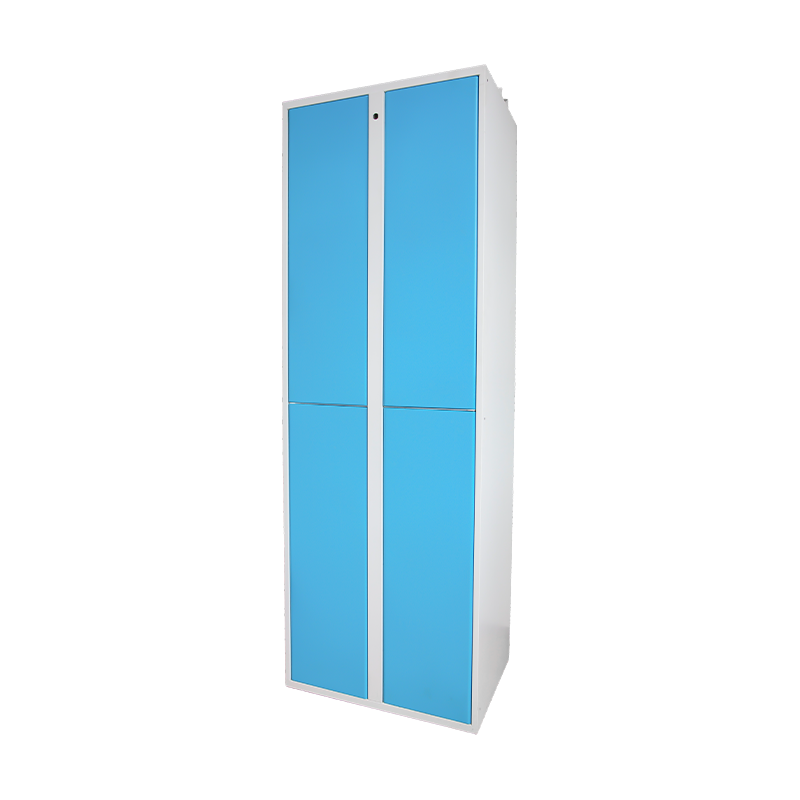
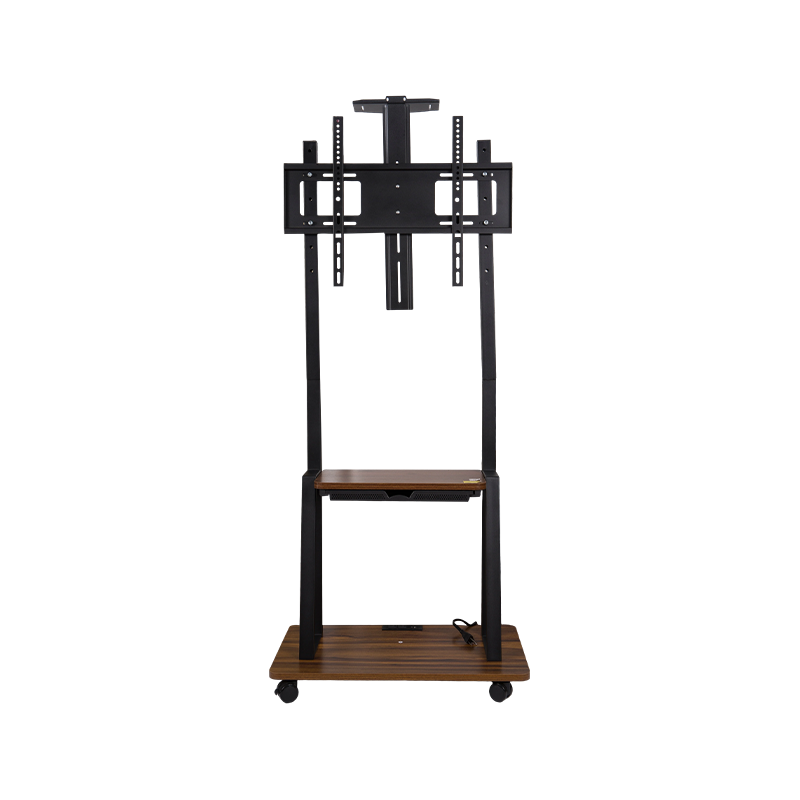 Custom Sheet Metal Parts and Enclosure FabricationExplore custom sheet metal parts including power supply housings, hinges, handles, cabinets, wardrobes, and TV stands for OEM/ODM projects.View Product →
In practice, the working ceiling looks like this: about 6 mm for daily production, up to 12 mm for occasional heavy jobs on a suitable brake, and beyond that a choice between plate rolling, a welded fabricated section, or machining from solid.
What Thickness Looks Like in Real Parts
Thickness decisions rarely come from the machine. They come from what the part has to survive once it is installed.
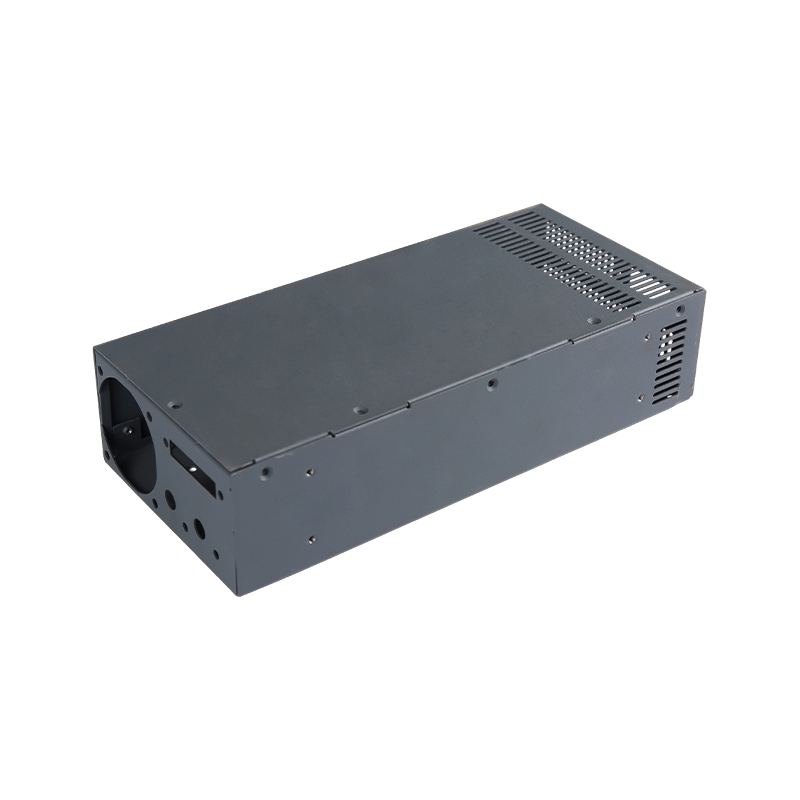
- Switch-mode power supply housings: 0.8 to 1.5 mm cold-rolled or galvanized steel, thin enough for tight corners and ventilation slots but rigid once fully formed.
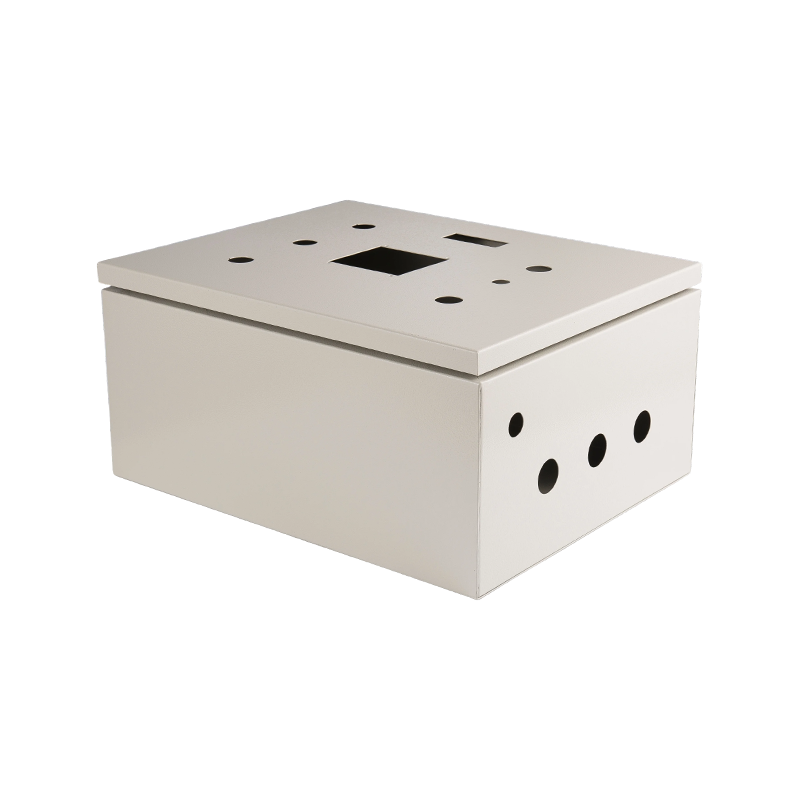
- Electrical boxes and cabinets: 1.2 to 3 mm, where wall thickness resists door sag, impact and screw pull-out at hinge points.
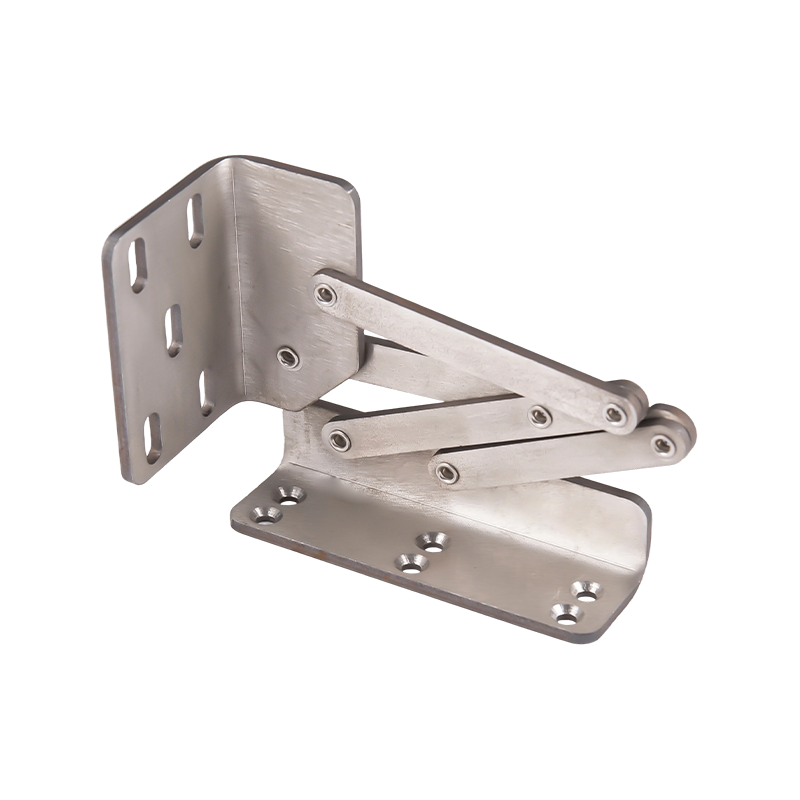
- Hinges and brackets: 2 to 4 mm, because load concentrates at the knuckle and pin.
- Mobile TV stands and support poles: 1.5 to 3 mm plate and tube, where stiffness matters more than saving weight.
- Medical cabinets and equipment covers: 1 to 2 mm stainless, selected for cleanability rather than structural strength.
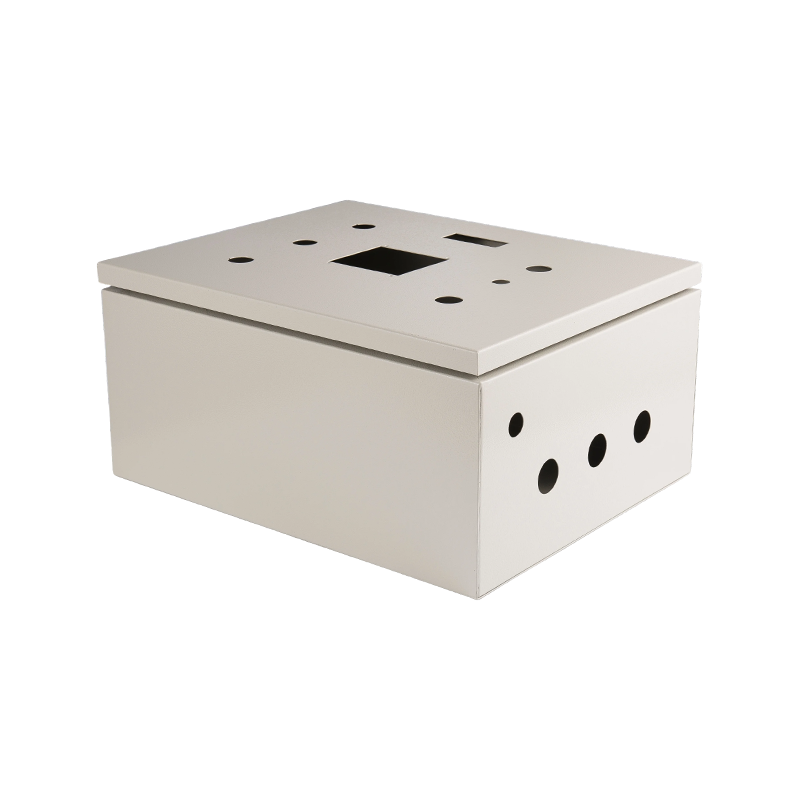 Custom Sheet Metal Distribution Box for Industrial ControlView a customizable cold-rolled steel electrical cabinet for power distribution and industrial control, with waterproof, dustproof, heat-dissipating construction.View Product →
When a project mixes several of these parts, the thickness decision spreads across an enclosure, a bracket and a handle at the same time. That is where custom sheet metal fabrication earns its place: one supplier holding consistent tooling and bend deductions across an entire assembly, instead of three vendors each forming to slightly different allowances.
Four Checks Before You Send a Drawing
A drawing that ignores bending mechanics will come back with a quote, then come back again with a revision request. These four checks take five minutes and prevent most of it.
Match the V-die to the thickness
An 0.8 mm cover needs a 6 mm die, not the 24 mm die still sitting in the machine from the last job. A V opening that is too wide gives a large radius and sloppy angles; one that is too narrow overloads the punch.
Run the tonnage numbers
Multiply thickness by bend length, apply the material factor, and compare with the machine rating in tonnes per meter. Stainless steel needs about 1.7 times the force of mild steel at the same thickness, so a job that is marginal in mild steel is impossible in 304.
Check the flange and hole distances
Air bending needs a minimum flange of roughly four times the thickness plus the inside radius. A 3 mm flange on 3 mm sheet will not form. Keep holes and slots at least 2.5 times the thickness plus the bend radius away from the bend line, or they will distort.
Confirm tolerances and springback
Typical formed-part tolerances run around plus or minus 0.5 mm on dimensions and about one degree on angles. Tighter than that demands dedicated tooling, trial bends and a longer setup, which is worth knowing before the drawing is released.
Thin-gauge parts deserve the same discipline. A 1 mm enclosure formed with a mismatched die can distort across the whole face, and no amount of rework hides it after powder coating. Reviewing thickness, tooling and tolerance together at quotation stage is cheaper than correcting them at assembly.
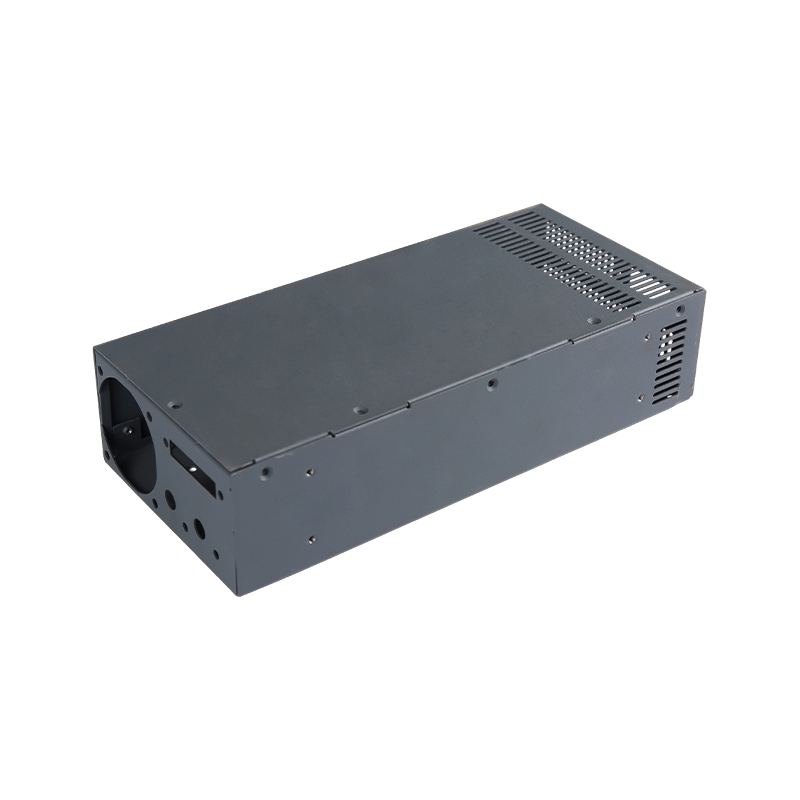 Custom Sheet Metal Switch Power Supply HousingReview a customizable galvanized steel or aluminum enclosure for power supplies, with EMI shielding, dust protection, and oxidation-resistant coating.View Product →
If your design mixes heavy brackets with light covers, send the full drawing set through custom sheet metal fabrication review first. Bend deductions, K-factors and tooling choices get agreed once, and every subsequent batch forms the same way.
Frequently Asked Questions
Can a press brake bend 10 mm steel?
Yes, but only if the tonnage and tooling line up. Ten millimeter mild steel needs roughly 80 tonnes per meter with an 80 mm V-die, so a standard 100-tonne brake can only manage about 1.2 m per stroke. Longer parts need a heavier machine or a different process.
Is the thickest cuttable sheet also the thickest bendable sheet?
No. Cutting and forming have different ceilings. A fiber laser may slice through much thicker plate than the press brake that would have to form it, so always design to the bending limit rather than the cutting limit.
Does a thicker sheet always need a larger bend radius?
Yes. Minimum inside radius scales with thickness, so 3 mm mild steel formed at 1 x thickness needs a 3 mm inside radius, while 1 mm sheet needs only 1 mm. Pushing below that risks cracking on the outside of the bend.
Is 0.5 mm sheet metal too thin to bend?
It bends fine, but the tooling gets fussy. Small V-dies, a sharp punch and good part support are needed, and thin panels are prone to oil-canning and handling dents. Tolerances usually have to open up slightly.
Why does stainless steel need so much more force?
Higher tensile strength and greater work hardening mean stainless resists forming more strongly than mild steel. Expect around 1.7 times the tonnage and noticeably more springback, which requires over-bending or a bottoming setup to hold the angle.
Sources
- Air-bend tonnage and V-die selection tables published by press brake and tooling manufacturers
- European cold-rolled steel sheet standards (EN 10130, EN 10088-2) and ASTM aluminum temper data
- Standard fabrication handbooks covering minimum bend radius, flange length and hole-to-bend clearance rules